The Delmarva fox squirrel is an endangered subspecies of the fox squirrel that lives in parts of Maryland, Delaware, and Virginia. Its numbers have been greatly reduced over the past century by habitat loss due to agriculture, logging, and urban development. In recent years, conservation efforts have led to a rebound in the population of this rare squirrel, creating hope that it might be saved from extinction.
Unfortunately, a new report from the Center for Biological Diversity contains troubling news for the Delmarva fox squirrel. The report lists the squirrel among the five animal species most at risk from rising seas due to global climate change.
According to the report, if sea levels rise by six feet by the end of this century, half of the squirrel's habitat would be underwater. The Delmarva fox squirrel requires old growth pine and hardwood forest, which has already been greatly reduced over much of its historical range. If the sea level rises at the rate that many climate scientists predict, this will leave few places for this squirrel to find refuge.
Even a more modest sea level rise would seriously reduce the already modest available habitat for the Delmarva fox squirrel. If governments, corporations, and citizens don't take steps immediately to reduce carbon emissions, this and many other species could soon live only in our memories.
Sunday, December 15, 2013
Sunday, December 8, 2013
Squirrel Facts: The Cream-Colored Giant Squirrel
The cream-colored giant squirrel is a member of the genus Ratufa, or Oriental giant squirrel, which also includes the Indian giant squirrel. The cream-colored giant squirrel, also called the pale giant squirrel, lives in southeast Asia, in parts of Brunei, Indonesia, Malaysia, and Thailand. It is the only species of giant squirrel on the island of Borneo. Unfortunately, it is believed extinct in Singapore and Vietnam, where it used to be common.
Despite the name, the cream-colored giant squirrel has several species which vary widely in appearance, some of them being quite dark in color. The coloring on the back ranges from dark-brown to gray, while the belly may be dark yellow or creamy white. The ears are short and round.
This squirrel is quite large. The body length is about 13-14 inches, and the strikingly long tail is 14-17 inches. Total body weight can be up to almost 3 1/2 pounds. In spite of its large size, the cream-colored giant squirrel moves about easily in the upper branches of trees, coming to the ground only occasionally to cross gaps in the forest canopy.
Like most tree squirrels, the cream-colored giant squirrel is diurnal, or active during the day. It usually forages for food during the early morning and evening hours, and rests during the middle part of the day. Favored foods include seeds, leaves, and bark, supplemented with nuts, fruits, insects, and bird's eggs.
Nests are often made in cavities in trees. During the breeding season, the female will construct a large drey, or nest, high in the trees. The drey is made of twigs and is globular in shape, similar to the familiar nests built by North American gray squirrels, but much larger, about the size of an eagle's nest. She gives birth to and cares for her young in this nest.
The cream-colored giant squirrel has an unusual eating habit. Most squirrels will sit upright with their tails arched over their backs while feeding. This species, by contrast, likes to balance itself on a tree branch, with its body extended outward on one side of the branch, and its tail draped off the other side as a counterweight.
Although not considered endangered, the cream-colored giant squirrel is, as noted before, already extinct in parts of its former range. With deforestation and habitat loss continuing unchecked in much of southeast Asia, it is more important than ever that beautiful species like this, the resources that they need to survive, and the environments in which they live, are protected.
![]() |
| In Singapore it remains only on this postage stamp |
Despite the name, the cream-colored giant squirrel has several species which vary widely in appearance, some of them being quite dark in color. The coloring on the back ranges from dark-brown to gray, while the belly may be dark yellow or creamy white. The ears are short and round.
This squirrel is quite large. The body length is about 13-14 inches, and the strikingly long tail is 14-17 inches. Total body weight can be up to almost 3 1/2 pounds. In spite of its large size, the cream-colored giant squirrel moves about easily in the upper branches of trees, coming to the ground only occasionally to cross gaps in the forest canopy.
Like most tree squirrels, the cream-colored giant squirrel is diurnal, or active during the day. It usually forages for food during the early morning and evening hours, and rests during the middle part of the day. Favored foods include seeds, leaves, and bark, supplemented with nuts, fruits, insects, and bird's eggs.
Nests are often made in cavities in trees. During the breeding season, the female will construct a large drey, or nest, high in the trees. The drey is made of twigs and is globular in shape, similar to the familiar nests built by North American gray squirrels, but much larger, about the size of an eagle's nest. She gives birth to and cares for her young in this nest.
The cream-colored giant squirrel has an unusual eating habit. Most squirrels will sit upright with their tails arched over their backs while feeding. This species, by contrast, likes to balance itself on a tree branch, with its body extended outward on one side of the branch, and its tail draped off the other side as a counterweight.
Although not considered endangered, the cream-colored giant squirrel is, as noted before, already extinct in parts of its former range. With deforestation and habitat loss continuing unchecked in much of southeast Asia, it is more important than ever that beautiful species like this, the resources that they need to survive, and the environments in which they live, are protected.
Sunday, December 1, 2013
Squirrel Facts: The African Pygmy Squirrel
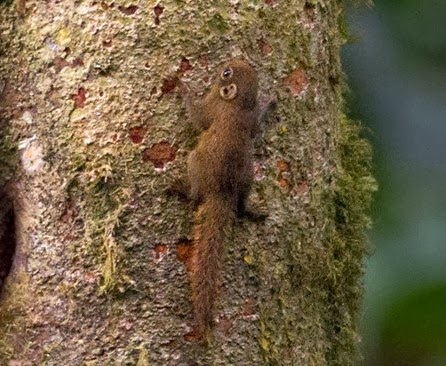
The African pygmy squirrel claims the distinction of being the world's smallest squirrel. This tiny tree squirrel, which is not much larger than a mouse, measures about 2.5-3 inches long with a tail about 2 inches long, and weighs around half an ounce. It is also one of the lesser-studied squirrels in the world. It inhabits forests of western central Africa, in the countries of Cameroon, Gabon, Equatorial Guinea, and northwestern Congo, although the range may actually be larger than this area.
African pygmy squirrels live comfortably in a variety of different kinds of forest habitat within their range. Whatever the forest type, they are most often found in the lower levels from the floor to about 5 meters. When not active, they spend their time in nests made of leaves. The coloring is buff on the back, and olive-white on the belly.
Like most tree squirrels, African pygmy squirrels are diurnal, or active during the day. They live alone, but are not fiercely territorial. When they sense danger, they make a faint peeping noise to warn nearby squirrels of the threat.
Days are spent foraging for food on tree trunks. Individuals run up and down in trees, pulling off pieces of bark. They are omnivorous, feeding on bark fragments, fungus, oil droplets, termites, ants, and pieces of fruit. Unlike most tree squirrels, African pygmy squirrels do not store food in caches.
Very little is known about the mating habits of African pygmy squirrels. It is thought that usually one or two young are born, and as with most tree squirrels, the females provide all of the care and feeding for the young.
Unfortunately, the African pygmy squirrel is classified as vulnerable. Although not much is known about its total numbers or even its range, this tiny squirrel is threatened by habitat loss through deforestation.
African pygmy squirrels live comfortably in a variety of different kinds of forest habitat within their range. Whatever the forest type, they are most often found in the lower levels from the floor to about 5 meters. When not active, they spend their time in nests made of leaves. The coloring is buff on the back, and olive-white on the belly.
Like most tree squirrels, African pygmy squirrels are diurnal, or active during the day. They live alone, but are not fiercely territorial. When they sense danger, they make a faint peeping noise to warn nearby squirrels of the threat.
Days are spent foraging for food on tree trunks. Individuals run up and down in trees, pulling off pieces of bark. They are omnivorous, feeding on bark fragments, fungus, oil droplets, termites, ants, and pieces of fruit. Unlike most tree squirrels, African pygmy squirrels do not store food in caches.
Very little is known about the mating habits of African pygmy squirrels. It is thought that usually one or two young are born, and as with most tree squirrels, the females provide all of the care and feeding for the young.
Unfortunately, the African pygmy squirrel is classified as vulnerable. Although not much is known about its total numbers or even its range, this tiny squirrel is threatened by habitat loss through deforestation.
Saturday, November 23, 2013
More Good News For the Mount Graham Red Squirrel
The Mount Graham red squirrel is in the news again, with some encouraging results of a recent census. The survey conducted by the Arizona Game and Fish Department, US Forest Service, and US Fish and Wildlife Service found an estimated population of the endangered squirrel at 272, a substantial increase from the 213 squirrels found in last year's survey.
This isolated subspecies of the North American red squirrel lives only at high elevations in a mountainous area of southeastern Arizona. Its numbers have dwindled in recent decades due to habitat loss, forest fire, and drought. It was once believed to be extinct, before being rediscovered in the 1970s. The recent increase in numbers may be the result of a healthy growing year for the pinecones that make up much of this squirrel's diet. However, overall numbers are still low enough to make this species vulnerable to any event, such as a forest fire, that could devastate the population in one fell swoop.
Efforts to restore the population of the Mount Graham red squirrel have had mixed results. Habitat conservation is the most important step. An effort a few years to build a series of rope bridges across a highway that traverses the squirrels' territory was, unfortunately, defeated due to state budget cuts. A captive breeding program being considered at the Phoenix Zoo may also help supplement this squirrel's numbers.
This isolated subspecies of the North American red squirrel lives only at high elevations in a mountainous area of southeastern Arizona. Its numbers have dwindled in recent decades due to habitat loss, forest fire, and drought. It was once believed to be extinct, before being rediscovered in the 1970s. The recent increase in numbers may be the result of a healthy growing year for the pinecones that make up much of this squirrel's diet. However, overall numbers are still low enough to make this species vulnerable to any event, such as a forest fire, that could devastate the population in one fell swoop.
Efforts to restore the population of the Mount Graham red squirrel have had mixed results. Habitat conservation is the most important step. An effort a few years to build a series of rope bridges across a highway that traverses the squirrels' territory was, unfortunately, defeated due to state budget cuts. A captive breeding program being considered at the Phoenix Zoo may also help supplement this squirrel's numbers.
Thursday, November 21, 2013
Squirrel Facts: A Uinta Ground Squirrel Returns Home
The Uinta ground squirrel is a squirrel of the western United States. It lives in colonies of between twenty and thirty individuals, in grasslands, meadows, and cultivated fields in parts of Utah, Wyoming, Montana and Idaho.
Looking a bit like a prairie dog that has lost weight, the Uinta ground squirrel has a brown back, slightly paler on the sides, and buff belly fur. The tail is black and brown, and the face and ears are cinnamon color. These squirrels measure about 11-12 inches in length, and the tail is about 3 inches long. They eat mostly seeds and green plants, but supplement this diet with insects and some small animals.
Uinta ground squirrels are active throughout the day, but only for about 3 1/2 months out of the year. From early fall until spring these squirrels hibernate in their underground burrows. The summer months are busy. In addition to gathering sufficient food to last through the long winter, females give birth to and raise litters of 4 to 8 young. The young typically leave the burrow and begin foraging about 24 days after being born.
One Uinta ground squirrel has recently made the news for its wide-ranging, if involuntary, travels. This squirrel (pictured below) was trapped by a truck driver at a highway rest stop near the Utah-Wyoming border. The unidentified trucker took the squirrel home to Wisconsin where he gave it as a gift to a family in the Madison area. After about two months, the family realized that the wild ground squirrel would never make a good pet, and they turned it over to the Four Lakes Wildlife Center, which is a division of the local Humane Society.
The species is not native to Wisconsin, so the most like course of action was, sadly, euthanasia. Fortunately, the wildlife center has been able to find a volunteer to transport the Uinta ground squirrel back to Utah. If all goes well, the squirrel will soon be back in its familiar habitat.
Looking a bit like a prairie dog that has lost weight, the Uinta ground squirrel has a brown back, slightly paler on the sides, and buff belly fur. The tail is black and brown, and the face and ears are cinnamon color. These squirrels measure about 11-12 inches in length, and the tail is about 3 inches long. They eat mostly seeds and green plants, but supplement this diet with insects and some small animals.
Uinta ground squirrels are active throughout the day, but only for about 3 1/2 months out of the year. From early fall until spring these squirrels hibernate in their underground burrows. The summer months are busy. In addition to gathering sufficient food to last through the long winter, females give birth to and raise litters of 4 to 8 young. The young typically leave the burrow and begin foraging about 24 days after being born.
One Uinta ground squirrel has recently made the news for its wide-ranging, if involuntary, travels. This squirrel (pictured below) was trapped by a truck driver at a highway rest stop near the Utah-Wyoming border. The unidentified trucker took the squirrel home to Wisconsin where he gave it as a gift to a family in the Madison area. After about two months, the family realized that the wild ground squirrel would never make a good pet, and they turned it over to the Four Lakes Wildlife Center, which is a division of the local Humane Society.
The species is not native to Wisconsin, so the most like course of action was, sadly, euthanasia. Fortunately, the wildlife center has been able to find a volunteer to transport the Uinta ground squirrel back to Utah. If all goes well, the squirrel will soon be back in its familiar habitat.
Saturday, November 16, 2013
The Squirrel Gardens of Japan
Amazingly, this is a real thing. According to a recent post on the gaming website Kotaku.com, Japan has a number of squirrel gardens, or risu-en. These gardens are just what the name suggests: parks or zoos where people can go to be surrounded by squirrels. The most famous of these, Machida risu-en, is located in Tokyo. But there are several others in various locations throughout Japan.
Different squirrel parks apparently specialize in different breeds of squirrels, with some featuring multiple species. Also, the parks differ in whether or not feeding and handling of the squirrels is encouraged. Some of the parks also have other small animals, but the squirrels are clearly the main attraction.
Below are a few more photos from the Kotaku.com story. The official website for the Machida risu-en squirrel park can be seen here. For some reason, I feel a sudden urge to plan a visit to Japan!
![]() |
| I'm guessing this is from one of the parks that doesn't encourage feeding |
Below are a few more photos from the Kotaku.com story. The official website for the Machida risu-en squirrel park can be seen here. For some reason, I feel a sudden urge to plan a visit to Japan!
Tuesday, November 12, 2013
Squirrel Facts: The Barbary Ground Squirrel
The Barbary ground squirrel is a squirrel of northwestern Africa, where it inhabits dry scrubland, grassland, and rocky areas up to an altitude of about 13,000 feet. The only squirrel in Africa north of the Sahara desert, it is native to Morocco and Algeria, and has also been introduced to the Canary Islands. Its body measures about 6-9 inches in length, with a bushy tail that is about as long as the body.
This squirrel is grayish brown or reddish brown in color. Its most recognizable feature is a white stripe running down each side of the body, and sometimes a stripe running down the middle of the back. The belly is a pale gray, and the tail has gray and brown bars. It prefers to live in rocky environments, where it may burrow in the ground or make nests within the crevices of large rocks. Like most ground squirrels, Barbary ground squirrels live in colonies made up of multiple families.
This squirrels are sociable, and can frequently be seen foraging food in the morning and evening hours. In areas frequented by humans, they show little fear and will often eat from people's hands. They are primarily herbivores, and their favorite food is the olive-like fruit and seeds of the argan tree. While plentiful in any areas where the source of this food is secure, if there is a food shortage these squirrels will migrate to another area. Barbary ground squirrels may breed twice a year, with up to four young in a litter.
This squirrel is grayish brown or reddish brown in color. Its most recognizable feature is a white stripe running down each side of the body, and sometimes a stripe running down the middle of the back. The belly is a pale gray, and the tail has gray and brown bars. It prefers to live in rocky environments, where it may burrow in the ground or make nests within the crevices of large rocks. Like most ground squirrels, Barbary ground squirrels live in colonies made up of multiple families.
This squirrels are sociable, and can frequently be seen foraging food in the morning and evening hours. In areas frequented by humans, they show little fear and will often eat from people's hands. They are primarily herbivores, and their favorite food is the olive-like fruit and seeds of the argan tree. While plentiful in any areas where the source of this food is secure, if there is a food shortage these squirrels will migrate to another area. Barbary ground squirrels may breed twice a year, with up to four young in a litter.
Subscribe to:
Posts (Atom)